"A thousand-mile journey begins with a single gallop — may 2026 carry you swiftly toward new horizons."

The Horse is a symbol of speed, vitality, and forward momentum. In Chinese culture, the phrase 马到成功 (ma dao chéng gōng) — “Success arrives swiftly, like a victorious horse” — captures the energy the Horse brings: movement, ambition, and the confidence to advance.
The Horse Gallops In
The Horse is one of the most dynamic signs in the Chinese zodiac — a symbol of speed, strength, and purposeful movement. It embodies vitality, ambition, and the instinct to advance. In a Fire year, that energy intensifies: boldness rises, momentum accelerates, and the impulse to act becomes unmistakable.
It’s a year defined by motion — and by how people choose to channel it.
Understanding the 60-Year Cycle and the Fire Horse
The Chinese zodiac follows a 60‑year cycle that pairs each of the twelve animals with one of five elements — Wood, Fire, Earth, Metal, and Water. Each combination creates a distinct expression of energy, shaping how people interpret the mood, momentum, and character of the year.
Wood (木): Growth, expansion, flexibility
Fire (火): Transformation, passion, illumination
Earth (土): Stability, nourishment, balance
Metal (金): Structure, precision, consolidation
Water (水): Fluidity, depth, reflection
The Legend of the Zodiac
The origins of the zodiac trace back to the Great Race, a mythical contest set by the Jade Emperor, ruler of Heaven in Chinese folklore. He invited twelve animals to compete for a place as celestial guardians — their finishing order would determine the zodiac cycle.
The Horse was a strong contender, fast and confident, but near the finish line it was startled by the Snake, who had hidden along the path. In that split second, the Snake slipped ahead, placing the Horse seventh.
It’s a classic tale of unexpected rivalry — a reminder that even the swiftest competitors can be humbled by the smallest surprise.
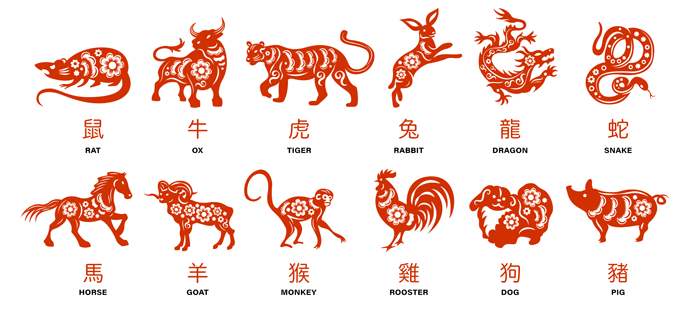
Twelve animals. Twelve years.
Each carrying its own spirit — shaping the personality, the energy, and the character of everyone born beneath it.
Celebrations and Traditions
Lunar New Year is a time of renewal, reunion, and symbolic beginnings. Families clean their homes to sweep away the old year’s energy, prepare abundant meals, and gather to honor ancestors and welcome good fortune. Firecrackers, red lanterns, and bustling markets fill the streets — each carrying its own meaning of protection, prosperity, and joy.
These traditions aren’t just festive; they reflect a deeper cultural logic about continuity, family, and starting the year with intention.
Regional Traditions
Lunar New Year is celebrated across East and Southeast Asia, but each region brings its own customs and interpretations. In China, families exchange hóngbāo (red envelopes), hang red lanterns, and prepare dishes meant to usher in prosperity and protection. In Vietnam, Tết features ancestral rituals and bánh chưng — the square rice cake symbolizing earth, family unity, and the renewal of spring. In Korea, Seollal centers on family gatherings, traditional dress, and honoring elders through rituals like sebae.
Across the global diaspora, communities adapt these traditions to new contexts while preserving the spirit of renewal. These variations show how culture travels — evolving in form, but not in meaning.
Běn Mìng Nián:
For those born in Horse years (1930, 1942, 1954, 1966, 1978, 1990, 2002, 2014), 2026 marks your běn mìng nián — your zodiac year. Traditionally, it’s viewed as a period of heightened energy and personal significance, a time to move with intention and pay closer attention to the choices that shape your path.
This belief isn’t about superstition; it reflects a deeper cultural logic about cycles, identity, and renewal — the idea that when your sign returns, so does a moment of reckoning and possibility.