
“The fortune you seek is in another cookie.”
— Traditional joke, modern truth
An American tradition at the end of a Chinese meal.
They arrive with the bill: folded cookies that crack open to reveal a surprise — a message, a moment, a mystery.
In the United States, the fortune cookie has become an expected finale to a Chinese meal, a ritual so familiar it feels timeless.
But here’s the twist: fortune cookies are neither traditionally Chinese nor rooted in China’s culinary heritage. Their story — like so many cultural traditions — took shape far from where people assume.
And the journey is anything but straightforward.
From Kyoto’s Shrines to San Francisco’s Chinatown.
Long before the golden, vanilla‑scented cookies appeared in San Francisco, bakers in 19th‑century Kyoto were crafting a savory cracker called tsujiura senbei, seasoned with miso and toasted sesame.
These were sturdy, hand‑grilled wafers pressed in heavy iron molds over black coals — closer to a rustic temple snack than a dessert.


The true innovation happened when bakers began incorporating omikuji. At local shrines and temples, visitors would buy these small printed slips for a modest fee to receive guidance on their future — with fortunes ranging from daikichi (great blessing) to daikyo (great misfortune).
What began as a spiritual ritual became the seed of a new culinary tradition.
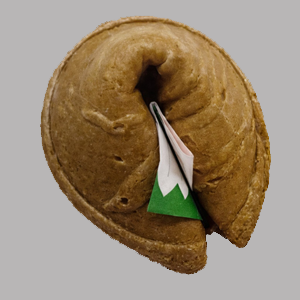
The bakers started tucking these folded fortunes into the outer crease of their dark, hand‑grilled crackers. In the original 19th‑century design, the paper wasn’t hidden inside a hollow center — it rested neatly in the fold.
A simple gesture, but a defining one: a message carried inside something humble and handmade.
The Tradition Continues
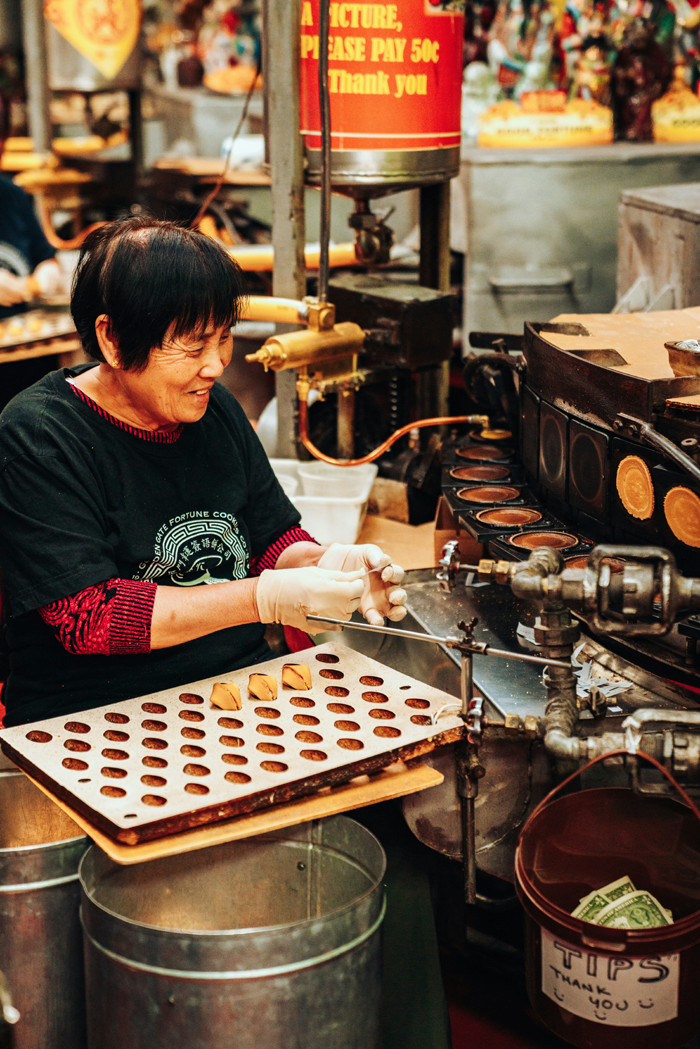
Since 1962, San Francisco’s Golden Gate Fortune Cookie Factory has resisted the shift to mass‑market production, choosing instead to make each cookie by hand. Visitors can still watch workers fold warm wafers one by one — a deliberate, craft‑based contrast to the high‑speed machinery used by industrial producers like Wonton Food.
By keeping the process manual, the factory preserves the tactile, artisanal origins of a snack that has otherwise become a symbol of large‑scale, global production.

"FortuNotes" Panda Express campaign
with messages of gratitude and giving.
Global Popularity
Today, the fortune cookie is more than a sweet ending to a meal — it has become a global product and a marketing canvas. From matcha‑infused versions in Tokyo to chocolate‑dipped treats in New York, the cookie has evolved far beyond its Kyoto origins.
Its power lies in its flexibility: a simple, portable shell that can carry anything from philosophical wisdom to brand messages. Companies have embraced this, turning the cookie into a tool for storytelling, gratitude campaigns, and even product launches.
A tradition that began as a temple cracker is now a global staple — proof that culture evolves as it moves, shaped by the people and places it encounters.
Celebrate National Fortune Cookie Day annually on July 20th!
The Ultimate Cultural Irony
The story comes full circle when Wonton Food tried to introduce fortune cookies in China — and the effort failed. As one executive told the Los Angeles Times, the cookies were simply “too American a concept.”
A tradition that began as a temple cracker had traveled so far, and changed so completely, that it no longer made sense in the place people assume it came from. That’s the real irony — and the clearest sign of how thoroughly the cookie evolved.
So the next time you crack one open, enjoy the fun — and remember the deeper cultural truth: traditions don’t stay still. They move, adapt, and become something new.
The Competitive Advantage
Learning about a culture's cuisine is one of the most direct ways to signal respect and build relationships. The connection between dining and business is proven time and time again.