
"I've seen zero evidence of any nation on Earth other than Mexico even remotely having the slightest clue what Mexican food is about or even come close to reproducing it. It is perhaps the most misunderstood country and cuisine on Earth."
— Anthony Bourdain
A Cuisine Rooted Before History Was Written
Long before the first Spanish ship crossed the Atlantic, the foundations of Mexican cuisine were already ancient.
Chili peppers cultivated by 7200 BCE. Squash by 4000 BCE. Corn — maize — domesticated from a wild grain called teosinte around 2000 BCE, refined over centuries into the foundation of a civilization.
The milpa — the intercropping system of corn, beans, and squash — was not just agricultural genius. It was a cultural philosophy made edible: three plants that support each other, none dominating, all sustaining.
The Story Begins With Corn
In the K'iche' Maya creation epic, the Popol Vuh, the gods fashioned human beings from white and yellow corn — after failing with mud and wood. The claim is not metaphor. Isotopic analysis of ancient Maya remains confirms that maize constituted 70 to 80 percent of their caloric intake. Their bodies were, at the molecular level, made from corn. The Popol Vuh's assertion was biochemically accurate.
For the Maya and Aztec civilizations, corn was never simply an ingredient. It was the foundation of civilization itself — woven into ritual, identity, and daily life
The tortilla — pressed from nixtamalized masa, a process of soaking corn in an alkaline solution that unlocks its nutritional value and transforms its texture — has been made in essentially the same way for over ten thousand years.
It is one of the most enduring human preparations in culinary history.
When Two Worlds Met at the Table
In 1519, Hernán Cortés landed on the shores of what is now Veracruz. With him came the Columbian Exchange — one of the most consequential transfers of ingredients, plants, animals, and culinary traditions in human history.
The Spanish brought pork, beef, chicken, dairy, wheat, rice, olive oil, garlic, and cinnamon — all unknown in Mesoamerica. What the Spanish found was equally transformative — chocolate, vanilla, tomatoes, avocado, chili peppers, squash, and corn, none of which existed in Europe.
Two culinary worlds met. What emerged belonged to neither — and to both.
Mole, Mexico's most complex sauce, is the embodiment of that encounter. A single mole negro from Oaxaca can contain over thirty ingredients — indigenous chilies, chocolate, and tomatoes layered with Spanish-introduced almonds, raisins, and cinnamon. No two versions are identical. It took centuries to develop and cannot be rushed. It is, in itself, a history lesson in a bowl.
The Tianguis: Where Food Becomes Community
Before the Spanish arrived, the Aztec market at Tlatelolco was one of the largest marketplaces in the world. The Spanish conquistador Bernal Díaz del Castillo, who had seen the markets of Rome and Constantinople, was so astonished by Tlatelolco that he wrote he could find no words adequate to describe it.
The word tianguis comes from the Nahuatl tianquiztli — marketplace. These open-air markets, which have existed in Mexico since pre-Columbian times, are not merely commercial spaces. They are the living infrastructure of Mexican social life — where neighbors meet, where regional food traditions are preserved, where the relationship between producer and consumer remains human and direct.
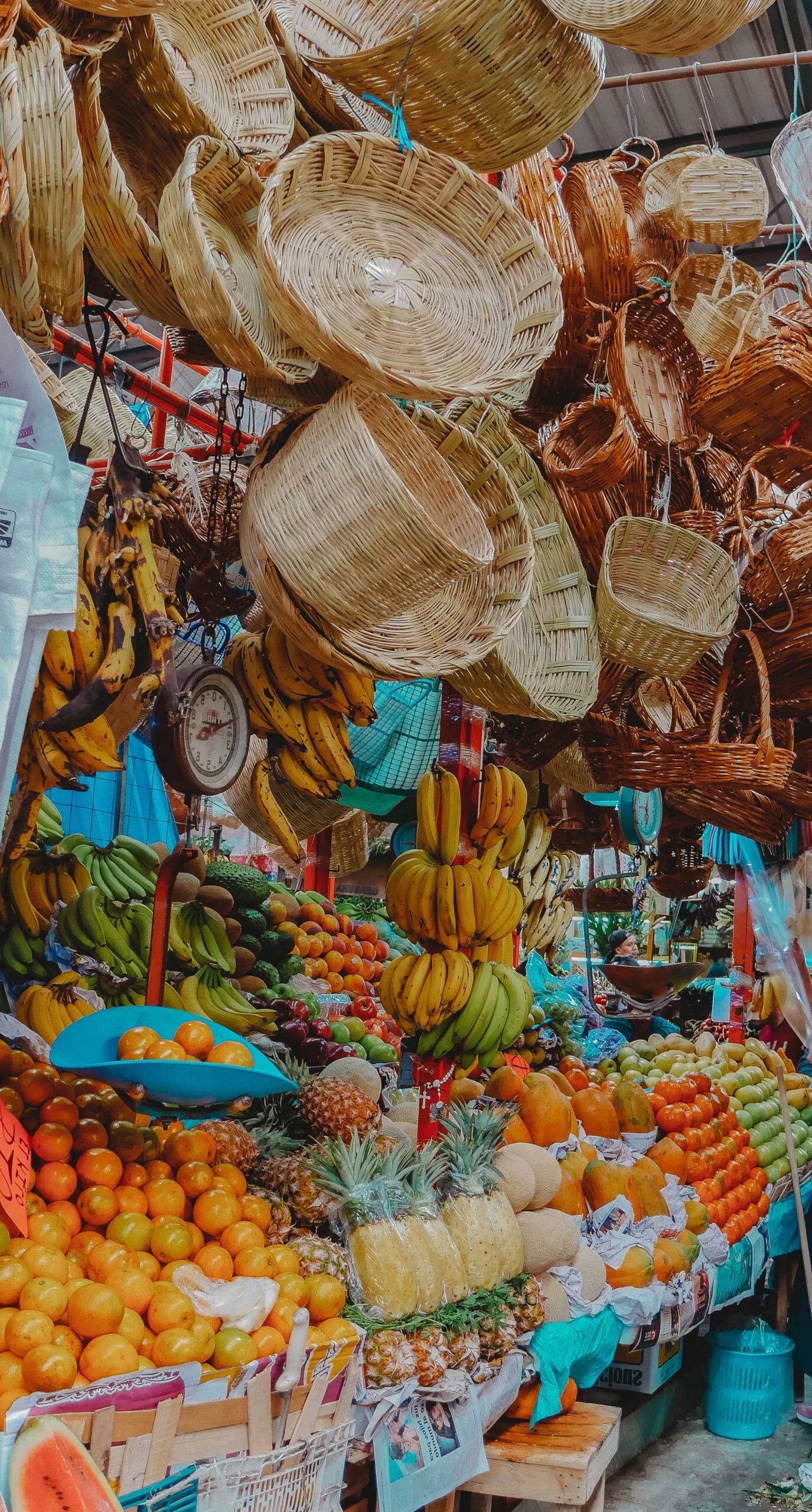
Nobel Prize-winning poet Pablo Neruda traveled Mexico for years and wrote simply:
"Lo recorrí por años enteros de mercado a mercado. Porque México está en los mercados."
(I traveled from market to market for years. Because Mexico is in the markets.)
The tianguis persists today across every Mexican city and town, largely unchanged from its pre-Hispanic roots.
It is one of the most durable cultural institutions in the Americas. Commerce as community. Transaction as relationship.
A Cuisine of Regions
Like China, Mexico is not one flavor. It is a country of distinct regional culinary identities, each shaped by geography, climate, indigenous tradition, and history.
Oaxaca — known as "the land of seven moles," each one a different depth of complexity. Oaxacan cuisine is considered the most direct heir to pre-Columbian tradition, and its markets are among the most celebrated in Latin America.
Yucatán — shaped by Maya civilization, characterized by achiote, citrus marinades, and cochinita pibil — slow-roasted pork wrapped in banana leaves, cooked in underground pits, a technique with roots in pre-Columbian cooking.
Veracruz — Mexico's Caribbean coast, shaped by African, Spanish, and indigenous influences. Seafood, black beans, and aromatic spice pastes reflect a layered colonial history.
Puebla — the birthplace of mole poblano, and of chiles en nogada — poblano chiles filled with a mixture of fruits and meat, topped with walnut cream and pomegranate seeds, in the colors of the Mexican flag. A dish that became the symbol of Mexican independence.
The North — cattle country, shaped by ranching culture. Flour tortillas, beef, grilled meats, and the hearty simplicity of a borderland cuisine that would travel north and become something new.
How Culture Travels: The Story of Tex-Mex
Food doesn't respect borders. It never has.
In 1845, Texas became part of the United States. The border moved. The people did not.
The Tejanos — Spanish-speaking Texans of Mexican descent — kept cooking what they had always cooked: corn, beans, chili peppers, and beef. But the ingredients available north of the new border were different. Wheat flour was more accessible than corn. Cattle ranching meant more beef. Dairy was abundant. Yellow cheddar cheese — not a Mexican ingredient — entered the kitchen.
The result was not Mexican food. It was a cuisine that demonstrates what happens when cuisines cross borders.
The term "Tex-Mex" originated not as a food category but as an abbreviation for the Texas-Mexican Railway, chartered in 1875. By the 1920s it described the Tejano people themselves.
Only in 1972, when British food writer Diana Kennedy published The Cuisines of Mexico, did Tex-Mex become its own named cuisine — though not by design. Kennedy, who had spent little time in the United States and was largely unfamiliar with Tejano culture, harshly dismissed the "mixed plates" served in "so-called Mexican restaurants" north of the border.
The result was not what Kennedy intended. As Texas food writer Robb Walsh later wrote: "We can all thank Diana Kennedy for inadvertently granting Tex-Mex its rightful place in food history. By convincing us that Tex-Mex wasn't really Mexican food, she forced us to realize that it was something far more interesting: America's oldest regional cuisine."
Chef Rick Bayless, who said he grew up on Tex-Mex in Oklahoma, put it simply: "When people cook from the heart, there isn't a right, or wrong, way to do it."
What Mexican Food Culture Reveals
For anyone doing business in Mexico, the table is never just about food.
The comida — the unhurried midday gathering — is where trust is built and relationships are confirmed. In Mexico, business is rarely discussed over a meal. The meal itself is the work — building the trust that makes business possible.
The tianguis reveals the same logic at a different scale. Commerce in Mexico has never been purely transactional. It is relational, communal, and embedded in the rhythms of community life that predate the Spanish conquest by centuries.
¡Buen provecho!
Gracias, igualmente.
The Competitive Advantage
Learning about a culture's cuisine is one of the most direct ways to signal respect and build relationships. The connection between dining and business is proven time and time again.